Every year on 28th April, the world unites to mark the World Day for Safety and Health at Work, a global observance led by the International Labour Organization (ILO) to promote safe, healthy, and decent working conditions. In 2026, this day carries even greater urgency as industries evolve, technology advances, and workplace risks become more complex. Across Kenya and Africa, the call is clear: prevention must become culture, not reaction.
The World Safety Day 2026 event brings together safety professionals, employers, employees, policymakers, trainers, students, and community leaders under one powerful theme — protecting lives through knowledge, discipline, innovation, and collective responsibility.
The Purpose of World Safety Day 2026
The core objective of World Day for Safety and Health at Work 2026 is to strengthen global awareness about occupational safety and health (OSH) while reducing workplace injuries, diseases, and fatalities. It is not merely a ceremonial event. It is a strategic platform to:
Promote a proactive safety culture.
Encourage compliance with occupational health and safety regulations.
Highlight emerging risks in modern workplaces.
Equip organizations with practical safety solutions.
Inspire leadership accountability in safety management.
In Kenya, where construction, manufacturing, transport, agriculture, and informal sectors continue to grow rapidly, the need for structured safety systems is more important than ever. Safety is not a luxury; it is an economic and moral necessity.
Ambassador of Safety: Leadership in Action
At the heart of the World Safety Day 2026 initiative stands Ambassador Steve Mbugua, widely recognized as the Ambassador of Safety. As a books author, trainer, coach, and motivational speaker, he has dedicated his platform to advancing workplace safety awareness across Kenya and Africa.
His commitment goes beyond speeches. Through training programs, public engagements, safety campaigns, and digital platforms, he emphasizes that safety is leadership in action. A safe workplace reflects responsible management, empowered employees, and sustainable growth.
The Ambassador of Safety uses World Safety Day as a mobilization moment — calling organizations, institutions, and communities to move from compliance to commitment.
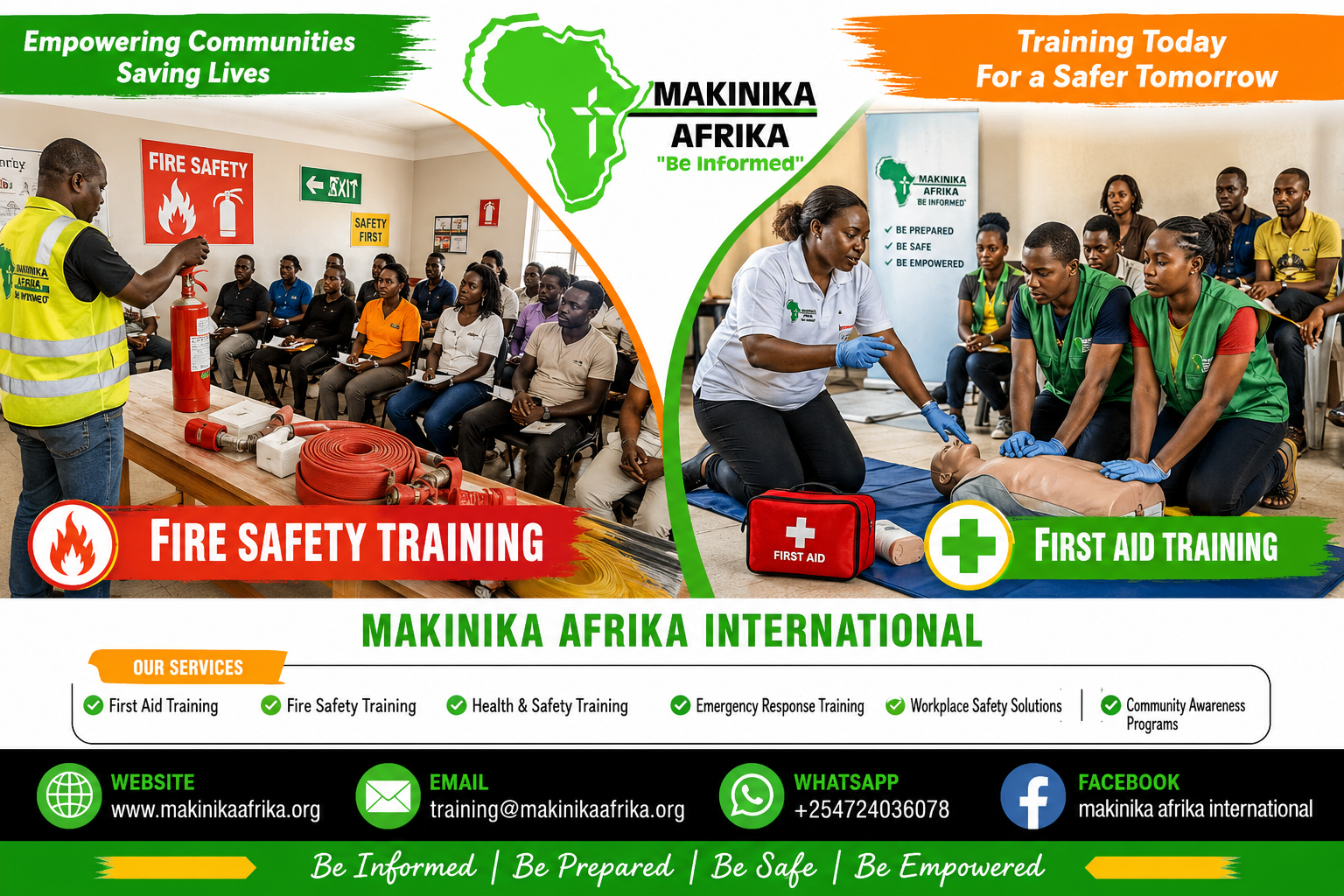
Makinika Afrika International: Leading in First Aid and Safety Training
A key stakeholder highlighted in the World Safety Day 2026 campaign is Makinika Afrika International, recognized as a leading provider of first aid and safety training in Kenya and across Africa.
Makinika Afrika International plays a critical role in:
Certified First Aid Training
Occupational Health and Safety Training
Fire Safety and Emergency Response Training
Workplace Risk Assessment Programs
Safety Audits and Consultancy
Capacity building for organizations and institutions
Training is the backbone of prevention. When workers are equipped with practical knowledge and hands-on skills, accidents reduce significantly. Makinika Afrika International continues to set the standard in professional safety education, helping organizations transition from reactive crisis management to proactive risk control.
World Safety Day 2026 highlights the importance of structured training partnerships that build resilient and safety-conscious workplaces.
Nairobi Safety Shop: Supporting Safety with Quality Equipment
Another major stakeholder featured in the World Safety Day 2026 initiative is Nairobi Safety Shop, a trusted supplier of high-quality personal protective equipment (PPE) and safety solutions.
Prevention requires both knowledge and equipment. Nairobi Safety Shop supports industries by providing:
Helmets and head protection
Reflective jackets and high-visibility wear
Safety boots and gloves
Fire extinguishers and fire safety equipment
First aid kits and medical supplies
Industrial protective gear
Access to reliable safety equipment reduces exposure to hazards and reinforces a culture of protection. World Safety Day 2026 emphasizes that safety is a shared responsibility — employers must provide protective equipment, and employees must use it consistently.
Why World Safety Day 2026 Matters More Than Ever
Workplace risks are evolving. Automation, digitalization, climate change impacts, road transport challenges, and rapid urban development introduce new hazards. In Kenya, road safety, construction site accidents, electrical hazards, fire outbreaks, and inadequate emergency preparedness remain pressing concerns.
World Day for Safety and Health at Work 2026 focuses on:
Prevention of workplace injuries and fatalities.
Strengthening compliance with occupational safety laws.
Promoting mental health and psychological safety at work.
Encouraging safety innovation and technology integration.
Building safety leadership from top management to frontline workers.
A single workplace accident can cause financial loss, legal consequences, reputational damage, and emotional trauma. Prevention is always cheaper and wiser than correction.
Safety as a Culture, Not an Event
While World Safety Day 2026 is marked on a specific date, its impact must extend beyond one day. Organizations are encouraged to:
Conduct safety audits.
Review risk assessment procedures.
Train employees regularly.
Establish clear emergency response plans.
Promote reporting of near-miss incidents.
Invest in certified safety training programs.
Safety culture develops when leadership models discipline, when employees take responsibility, and when systems are consistently reinforced.
The Economic and Social Impact of Workplace Safety
Safe workplaces are productive workplaces. Studies consistently show that companies with strong safety systems experience:
Reduced downtime
Lower compensation costs
Higher employee morale
Improved reputation
Increased operational efficiency
On a national level, occupational safety contributes to economic stability, workforce sustainability, and social wellbeing. Protecting workers protects families, communities, and national development.
A Call to Action for Kenya and Africa
World Day for Safety and Health at Work 2026 is a powerful reminder that safety is not optional. It is foundational. The collaboration between Ambassador Steve Mbugua, Makinika Afrika International, and Nairobi Safety Shop demonstrates a united effort to advance safety education, training, equipment provision, and leadership engagement.
Organizations, schools, government institutions, SMEs, and community groups are encouraged to actively participate by:
Hosting safety awareness sessions.
Enrolling staff in certified first aid and occupational safety training.
Reviewing compliance with national safety regulations.
Investing in quality protective equipment.
Promoting safety as a shared responsibility.
Conclusion
World Safety Day 2026 is more than a calendar observance; it is a movement toward protecting lives through knowledge, preparedness, and collective responsibility. With the leadership of the Ambassador of Safety, the expertise of Makinika Afrika International, and the practical solutions provided by Nairobi Safety Shop, Kenya continues to advance toward a safer and more resilient workforce.
Safety is protection. Safety is productivity. Safety is leadership. And in 2026, the commitment to workplace safety must be stronger than ever before.